Saturday, March 14, 2009

Hydraulic Mysteries Explained


  had a real breakthrough on the car yesterday... i discovered that one of my rear brake hoses was almost totally plugged up, which explains the poor fluid flow from that side during bleeding and most of the other weird symptoms.
  ive now replaced nearly every component possible: master cylinder, calipers, pads, hoses, wheel cylinders, shoes... i even replaced the brake fluid-specific blue inlet hoses that link the reservoir to the MC ($6 a foot!). i almost screwed myself by using regular fuel hose, then checked the internet at the last second and found that a very specific type of rubber hose is used; standard fuel hose will dissolve and break apart in a matter of days...


the new seals are clearly a huge improvement, just by looking at them next to the old (new on the left)


and once installed on the piston it became even more obvious what an improvement it was:


instead of trying to bend the tabs on the existing spring seat i just used one from a spare MC that was already a good fit. on the left is the proper one with tabs bent inward to grip the tail of the piston:


the complete assembly...hopefully the last time i have to look at it for many years:


theres really nothing left to replace besides the rotors and drums, so hopefully this will be the end of the saga. i've even checked every section of hard line with my vacuum pump to make sure it flows well. 


i got everything mounted up and tight just before the rain started. it'll be next weekend before any more dry weather...
  

Wednesday, March 11, 2009

M.C.A. '09 continued


  upon closer inspection of my MC yesterday i noticed a small flaw in the rear piston which controls the rear brake circuit: its spring seat doesnt grip the tail of the piston like its supposed to, so that could cause the valving to not work properly. so maybe that had something to do with it, maybe not. also, a member of the 411/412 forum suggested polishing the brass shim "flap valve" and its mating surface on the piston with 2000 grit, so i'll try that too. 


  i also removed the reservoir and hoses to clean it. there was some black goo in the bottom around the fluid outlets and the old blue hoses have always leaked a little bit. i plugged the inlet hoses with a pencil like i usually do for fuel hoses, but the DOT3 dissolved them like acid, and now theyre stuck. i was going to replace them anyway, i guess...


  the holes in the body that the hoses pass through had been suffering with oozing brake fluid since i bought the car. luckily the paint damage wasnt too bad. note the third hole for the hose that feeds the clutch master, already punched open even though the wagon was never fitted with the 4-speed from the factory...


  below are the pistons, front is at the bottom, rear at the top. the front piston's spring is fastened to it with a small screw through the cap at the end, but the rear piston's spring doesnt have this part and instead relies on the stamped metal seat's friction fit to hold it all in place. i dont really see how this could have much of an affect since its all held together with pressure from the springs once assembled in the cylinder, but every detail counts, i guess. its this spring that controls the operation of the valving in the piston along with the brass flap valve and seal. 


  once my rebuild kit gets here i get to figure out a way to remove & replace the forward seals of each piston, the ones captured in deep grooves, without destroying them.

the tracking # shows delivery tomorrow...

Tuesday, March 10, 2009

412/6

while i'm waiting for my MC rebuild kit to arrive i have little else to do but troll the interweb for cool 412 stuff. a member of the 411/412 forum posted this link to a dude in Norway building a 412/911 hybrid:


aside from the obvious kick-ass engine transplant its pretty exciting to see that level of bodywork and suspension overhaul. threaded strut bodies, anyone? yes, please. 


and the 911 bumper/valance looks amazing on this car, solving the chin-less look that has always bothered me:


my own 412/porsche fantasy has always been a mid-engine conversion; cut out the rear seat and fit the entire 914 (or better yet, 914/6) engine/transaxle from a late model 2.0L, along with the rest of the porsche specific kit like rear disc brakes and interior. once again the Europeans show an enthusiasm for this car that has yet to catch on here...

Sunday, March 8, 2009

Master Cylinder Apocalypse '09


  two days ago i was ready to take the engine out, but needed to turn the car around in the street so i could back into the garage. i got in, started it, and stepped on the pedal to take it out of PARK, but something felt a little strange. i stepped harder and it sank all the way to the floor. the horror! 
  to make a long story short, i found out that the rubber cup seals inside the NOS master cylinder that i bought were in fact bad, in spite of my careful inspection & assembly. theres fluid leaking from one of the elbows and a small puddle on the floor:


 there was also some very light corrosion in one of the wheel cylinders that was preventing its piston from moving through its full stroke, which eventually broke free that morning, causing the collapse of the pedal under heavy pressure. that part cleaned up fine, but the real ball-buster is that i have to take the MC out again! the only positive about this whole mess is that i can use the seals from a rebuild kit intended for either a late type 3 or even a Rabbit...any 19.05mm (.75 inch) ATE cylinder, really, making the solution relatively cheap (around $20).


  i was so stunned when all this happened that i just sat there, looked up at the rear view mirror into my own eyes for some kind of explanation, then just whispered a "WTF?". i pumped the pedal a few times, but no change. if it had just been the wheel cylinder popping into place then i should have been able to recover at least some pedal pressure because the MC would have drawn more fluid from the reservoir and pushed it on down. but there was no improvement, and subconsciously i knew what that meant, ultimately. and i thought 1970s motorcycles had shitty brakes... maybe i should be running a '75 GL1000 setup, never had this kind nightmare with them, and they live outside all year.

Thursday, March 5, 2009

412 resurrection phase 2

  now that its running/driving its time to take it all apart. i've decided against converting to manual transmission because it's more important to me to have everything done by the fall so i can drive it, and it leaves me more time/money to spend on a proper engine rebuild and my strut modification:


  this is the KYB strut cartridge that can be used in conjunction with a slightly lowered spring perch to lower the front end about 2", bringing it level with the rear. it's intended for use on the VW Quantum/Audi 4000 and is a gas damper, perfectly valved for the heavy-duty stock springs of the 412. a simple adapter stub has to be made for where everything bolts up to the body, aside from that its pretty straightforward. i can finally take out the 160lbs of concrete mix i put in the trunk to force the nose down, poor-bastard-style. here's an example of the stub:


and the complete strut assembly, adapter fitted:


  also, the proper pistons are finally available with the high-compression, domed crowns, and they're only $200 for the full piston & cylinder set in the stock 90mm (1.7 liter) size:


  i want to try and convert to hydraulic lifters, which requires a new cam, but if i remember right the one thats in it now is pretty shot, and once the mechanical lifters are gone, i wont have to adjust the valves every 6000 miles...the only other engine work i want to do is get a good head job; sodium-filled (porsche style) exhaust valves, new valve guides/seats, smoothed ports, and resurfaced face. lots of work to do...

Wednesday, March 4, 2009

it's alive!


  got the 412 running yesterday, the little bastard started right up. then kept running like a top as if it hadn't been sitting outside for years soaking up rain. i even took it around the neighborhood a couple times and it drives just like it always has, and everything works: steady idle, positive shifts, light steering, all the lights & switches... i expected much worse. i'm so glad i've held on to that car, it really puts a smile on my face. 


 next: take the engine out and find out where all the oil is leaking from...

Sunday, March 1, 2009

brake saga nears end


  installed the new MC yesterday and got started filling/bleeding the system again. i rolled up a sheet of 2000 grit wet/dry sandpaper and ran it through the bore a few times with some WD40 to clean up the minor rust, washed it out with brake cleaner, then blew it out with compressed air. with a couple drops of fresh brake fluid on the seals the pistons slipped right in. 


  i used an old pump shaft to hold the pedal down while i cracked the bleeders open...


  one of the remanufactured calipers i bought last year has had its nipples replaced with oversized, SAE bleeders that actually dont fit right: when they're tight, the wrench flats disappear into the countersink so far that you cant get a wrench and a drain hose on at the same time, a real messy pain in the ass, so i had to go to a hydraulics parts supplier and get special long ones. they're kind of huge, but they allow a wrench and will tighten:

  left: original long-nose  right: oversize SAE 


  what a relief to finally see some progress. it took many cycles around the car at each wheel but they pumped right up. in fact, right now they're as good as they were for the last couple of years that i was driving the car, and i'm not totally finished yet. with a helper to pump the pedal i can get the last few bubbles out and get it "high & tight". in the end the cheapest kit worked the best: maybe i can use that fancy-lad vacuum kit to siphon milk from my nose or something...


Monday, February 23, 2009

new MC arrives!


  new master cylinder arrived today and its perfect. genuine German-made ATE right down to the boot & elbows. i decided to check the insides for any corrosion from sitting on the shelf for (?) years and found some very light pitting in the area between the outermost seal and the adjacent one, probably just from moisture in the air that was in that area.


 i got a good tip from the 411/412 forum to use a small wooden dowel mounted in a drill with some extra fine scotch-brite stuck to it like a flag. works like a flap-wheel and takes off minimal material, more of a polishing effect. 


  the seals are still pretty good, smooth and pliable. they're a little stiff, but not any more so than what i would get in a rebuild kit, and better yet they're already mounted. 
  as soon as it stops raining i can finish this job up, finally. what a saga...

Saturday, February 21, 2009

gas most foul


  since the brakes are on hold for a few days, theres time to start replacing fuel hoses and chasing fuel leaks...
  yesterday i was under the car all day dealing with the foulest old gasoline i've ever encountered. 5 years of sitting in the tank had reduced it to an orange-colored stank juice, and my attempt at starting the car a couple weeks ago had sent it pumping out all over.


  thats the underside of the tank with the evaporated-gas goo leaking out through the plug. my hoses were in much worse condition than i had expected to find...no wonder there was a golden shower when i turned it on:


  all together its about 4 feet of hose, maybe 7 or 8 individual lengths. the whole mess is in a pocket of space above the front end subframe and just under the gas tank, so pulling off ancient, frozen-on hoses makes for lots of contortion and cursing. i used genuine German 7mm fuel hose this time, a new fuel filter, and proper fuel-injection clamps:


  in the background you can just see a vent hose that has completely broken apart and separated from the tube leading back to the engine compartment. this hose runs all the way up to the filler neck, i'm still looking for a decent replacement...
  next i need to get a fuel pressure tester and make sure its adjusted to 28psi, a critical setting for the system to work properly. its something i never checked before, and i'm sure it needs an adjustment by now. 


Friday, February 13, 2009

i curse thee, four-twelve!


  after days of trying to bleed, i discovered today that my NOS master cylinder was rusted and only moving through half of its stroke. i guess thats what you get when you leave a drained system alone for months in a car with moisture-leak problems. the rear piston was so tightly rusted in place that i had to use a torch on the body and tap its face with a punch to break it loose. unfortunately, i broke off a piece of it, rendering it useless. 


  since the master cylinder lives inside on these cars, they are prone to rust problems due to condensation. VW thought that they were solving the problem of it being exposed to dirt and a relatively harsh environment outside, but they created a much bigger problem by hiding it under the dash. as a result, they all die a rusty death very quickly.
  but the best part about it is that to get to it/remove it, you have to remove the steering column and pedal assembly:

 thats it, hanging by the feed hoses from the reservoir (which is in the trunk, where the whole business should have been in the first place).  
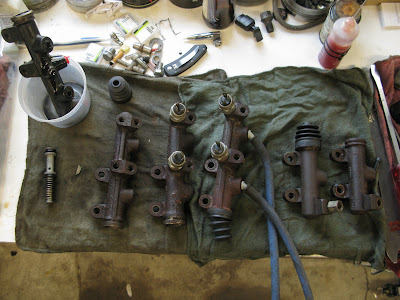
 i found my stash of spare brake MCs, and let them all soak in Liquid Wrench overnight, then set about trying to get some useable parts out of them. in the end, every one of them had either a damaged bore or a broken rear piston. bugger. 


  the type 4 used a totally unique design for the master cylinder, both externally (mounting) and internally (piston/cup dimensions), and replacement parts are very hard to come by. some crossover exists, namely the rubber lip seals; they are identical to the type 3, and the front piston is the same as a certain year of type 1. luckily i found a new one on ebay, should be here early next week, and i can finally finish with the brakes. what a saga...